A sad, but true story of a young man who wanted to be executed
This is the story of Jens Nielsen. Not a happy story
- quite the opposite. Jens Nielsen is famous, or at least known, for being the
last person in Denmark to be executed for crimes committed in peacetime. After
Jens was executed in 1892, nobody was executed before the death penalty was
abolished in 1930, but was then reintroduced in 1945 in connection with the
trial after the Nazi Occupation, where 46 of a total of 78 people sentenced to
death were executed. In 1951, the death penalty was abolished again. In the
military penal code, however, the death penalty existed until 1978 for certain
crimes.
But now it is about Jens Nielsen, who was executed despite the fact that he had
never killed another person or committed rape, the two crimes that, in addition
to "crimes against the kingdom", could result in the death penalty - or life
penalty, as it was called at the time.
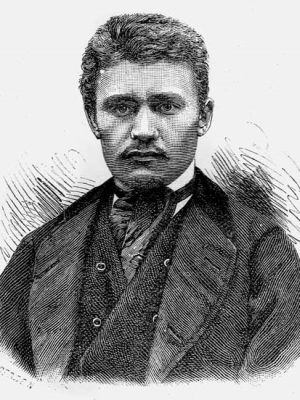
Jens Nielsen in prison before his execution
Jens Nielsen was born on November 21, 1862 in the small town Jyderup on the island of Zealand, and later he had a younger brother and not least a sister, with whom he later corresponded while in prison. His mother was an invalid, and his father originally made a living by making wooden shoes, but he fell into drinking and began to steal to satisfy his vice. He became known as a sheep thief, and in 1864 when Jens was two years old, the family were sent to a place called Holmstrup Poorhouse. Here, however, the father continued his drinking and his thefts, and he even stole his own wife's few belongings and sold them, and when she earned a little money from the work she had to do at the poorhouse (where only three families lived), he stole them too. Occasionally he would go on a drinking spree that lasted for several days, and after one that lasted so long that Jens' mother thought he was dead; she became so furious that she would not take him back, but filed for divorce, and she hated him for the rest of her life. The father later joined the Mormons, but this did not make him change his ways.
When Jens was about 3 years old, he started stealing fruit from neighborhood gardens so that he and his mother could have something to eat. He was occasionally caught red-handed, but since he had the ability to cry (squeeze out tears) "on command", he was typically allowed to go again. Especially after his parents divorced, he used his abilities to get food for himself and his mother, but when he was seven years old, both Jens and his disabled mother were placed on the larger Brokøb Workhouse in Jyderup, where coercion and beatings were the usual means of upbringing. Here, at the age of seven, Jens made his sexual debut with a 12-year-old girl (according to his autobiography). While the family lived here, Jens amused himself by bothering the other residents, for example by trampling flowers and herbs into the small plots of land where the residents were allowed to grow a little to supplement the diet of the workhouse. In addition, he threw ashes on the floor when the wives had just finished cleaning, and put frogs and toads in the pots when they cooked. This information comes from Jens' own statements to the prison chaplain, S. M. Hafstrøm, with whom he spoke a lot while he was later in Horsens Prison. His mother did not exactly promote a good upbringing either. If he was bothered by other children, she encouraged him to beat them.
Jens had a hard time giving up his thieving habits, and among other things he continued to steal fruit from all the village gardens, but now tears would no longer help him off the hook. At the age of ten he was sent to the Flakkebjerg Correctional Institution south of Slagelse - both because of the fruit thefts, but also because he also stole smaller things from the other residents of the poorhouse, and when he was in a village garden to steal fruit and vegetables anyway, he might as well sneak into the houses to see if he could "get hold of anything there". His mother protested vehemently, but that didn't help. Instead, she visited him when she could raise money for the trip. At the institution he was described as "well-gifted and with a will of steel". He was put to school, and he proved to have good abilities, but unfortunately it couldn't bring him money, so he continued his thefts. Just two months later he had to be transferred to another correctional institution, Landrupgård near Kolding in Jutland. His mother didn't like it, and complained to the parish council, but unfortunately without success. She did not have the opportunity to visit him at Landrupgård. The trip was simply too expensive. The stay there was not pleasant. He was locked in an attic when he did something that displeased the superintendent, and he was often "punished physically". He stayed at Landrupgård until he was confirmed, at the age of 15. At first, they did not want to let him be confirmed, as only "children who behaved properly" were allowed to do so, and Jens was not one of them. However, he ended up being confirmed in Almind Church in 1877. The children were not treated well at this correctional institution either. The founder of Nordisk Film Company (founded in 1906 and one of world's oldest film companies), Ole Olsen (1863-1943), who himself was at Landrupgård at the same time as Jens Nielsen and shared a room with him, wrote in his memoirs that he understood Jens Nielsen very well. He himself had once found him in the woodshed, hands tied behind his back and beaten by those who were supposed to educate him.
After his confirmation, Jens was sent to work on a farm near Fredericia north of Kolding. He worked there for almost 3 months; then he hads a fall out with the farmer, who thought he was lazy. Jens, who all his life hated working, had not moved the sheep to a new grazing area when all the grass had been gnawed away where they were, and the animals were therefore starving. Jens ran away from the farm, but first he tried to annoy the farmer. One of the cows was very aggressive and was therefore tethered away from the other cows. Jens sharpened one of the cow's horns, and then freed the cow, and hoped it would injure or perhaps even kill the other cows. However, it did not work out that way. After various detours (via towns in Jutland and on Funen like Lunderskov, Ribe, Kolding and Svendborg), he finally reached Copenhagen, where he arrived with 50 øre in his pocket. 50 øre in 1877 is equal to around $10 in 2025. This was of course not enough to live on, so he turned to theft again, and after less than 14 days in Copenhagen he was arrested during an attempted burglary. He was brought before the Copenhagen Criminal Court and sentenced to 25 lashes with the whip, which he did not consider anything special. He was used to being beaten more at the correctional institution. After serving his sentence, he was sent back to Flakkebjerg. He did not stay here long, however, because only 12 days later he ran away again, and again by detours, he ended up in Odense on Funen. Here he stole a watch from a ship in the Odense Canal and was arrested by the Odense Police and the Odense High Court sentenced him to 40 lashes, after which he was again sent to Landrupgård. Here Jens apparently had a relatively quiet life for about one year, except that he amused himself with some “girls of easy virtue" who also lived at the correctional institution. For some reason, which is not entirely clear, he hated the superintendents of both Flakkebjerg and Landrupgård with all his heart; a hatred that lasted throughout his life, which is clearly evident from his memoirs, where he wrote several hundred pages expressing his hatred for the two men. Even while he was in Horsens State Prison, he expressed to the prison chaplain a wish to have just "14 days of freedom, so that he could murder the two men". In a letter to his sister, he wrote that he "for special reasons that he would not mention, did not want to tell what evil they had done". In November 1878 he set fire to the institutions's cowshed and a few days later to the granary. A few months later he set fire to the farm's material depot, and in all cases the aim was for the fire to spread to the main building, but this did not work in either case. In January 1879 he was arrested for arson and sentenced to 2 years of reformatory work, and was imprisoned in Vridsløselille State Prison. Here he was put to weaving, to "learn a trade", but Jens did not want to learn a trade, since a trade was connected with work. He claimed to be ill, and instead he was made to "pick cordage", and since this was also boring, he complained about this, and instead was put to look after a bobbin winder (a small winder where yarn was spun). He liked this work. It was easy and he was given a third of the working day off. He used that free time to read, especially novels.
Whether it was because of the novel reading is not clear, but when Jens was released from Vridsløse, he felt an urge to go to the USA, where he believed he could get rich and live a life of partying without having to work for it. At that time it was not unusual for the authorities to give non-violent criminals who were considered incorrigible a one-way ticket to a place far away, see also the article about Christian Madsen: "The Danish con man who became an American hero". In this way, it was believed that they could give the criminal a second chance, as turned out to be the case with Christian "Chris" Madsen, who ended his days as a highly respected law enforcement officer in Oklahoma. And even if the criminal did not improve, at least they had gotten rid of him. Jens asked the superintendent at Landrupgård for money for a ticket, but they would not pay. Instead, he got a ticket, perhaps through his mother's intervention, paid for by the parish council in Jyderup, and via Hull in England he came to Quebec in Canada. Already on the journey to Hull he became acquainted with a "frivolous, Funen girl", whom he accompanied the rest of the way to Canada. Along the way he used most of the 10 kr his mother had given him for the journey to buy gifts for the girl, and when they were given $5 in Liverpool for the continued journey, he also spent it on the girl. On the way to America he sold most of his clothes and other belongings to fellow passengers in order to be able to give the girl gifts. This meant that when the ship reached Quebec and he had to part with the girl, he owned nothing.
He therefore had to work. He got a job laying a water main. It paid him 90 cents a day, it was hard work - and work, which he did not like. After five days he withdraw his salary ($4.50). He owed his landlord, but as he himself said, "he forgot that bill", and then travelled west, begging his way. Along the way he began to steal again and not least to defraud people who helped him along the way, for example with a place to stay. On his trip around eastern Canada, he came to Sherbrooke and Montreal, among other places. Here he also made a living through crime, and along the way he collected some loot, which he kept in a basket. However, it was stolen from him one night while he was sleeping, and then he got homesick and wanted to return to Denmark. Via New York, where he also made a living through theft, he came to Philadelphia. Here he was hired on a ship bound for Holland. From Rotterdam he traveled to Antwerp in Belgium, where he was again caught for theft and sent back to Holland with a ban on re-entering Belgium for the rest of his life. From Rotterdam he traveled to Harwich in England and from there to London. He was now 18½ years old, and wanted to return to Denmark, and when he heard of a Danish ship in the harbor, he wanted to see if he could get trip home. However, the ship was far out in the London harbor area, and as it got dark before he got there, he went to sleep on some cotton bales. Here he got a bright idea. The warehouses must contain large amounts of valuables, and by setting fire to the bales, he could use the panic to break in and steal from the warehouses. However, it was not that easy. From the cotton bales, the fire spread to the warehouses in the Royal Victoria Dock, and both these and several ships were set on fire and 170,000 square feet of buildings burned down. The fire caused damage worth 1.5 million pounds, an unheard of sum in 1881. This corresponds to an amount of almost 240 million USD in 2025 value. Unfortunately, the loot was not as good he had hoped; he only escaped with three uniform jackets and two caps. A few days later, he sold the stolen goods to a merchandise dealer for 6 shillings. Three days later, he set fire to a rope factory, Universal Works, in London, and that same evening he was arrested. Not for arson, but for burglary of a basement shop. For the burglary he was sentenced to two months' imprisonment, which he served in Chelmsford Prison from 19 February to 18 April 1881. The very day after his release he set fire to two places, at Brewer's Quay and London Bridge Wharf. The next day he committed another burglary; this time at the Danish Consulate General, where the consul had otherwise been very helpful and lent him money. He was again arrested and taken into custody at Newgate Prison until he was sentenced on May 2 of the same year to 1 year's hard labour, which he was to serve in Holloway Prison, a prison for women and young criminals. He remained there until 1 February 1882, when he was transferred to Bedford Prison, where he remained until he was released on 1 March 1882. At that time, no one suspected him of the fires.
In order for him to come home to Denmark, he was hired
as a cabin boy on a Norwegian ship, which, after a short stay in Norway,
continued to Helsinki in Finland. Unfortunately, being a cabin boy meant that he
had to work, so in Helsinki he escaped and took a train to Åbo, present day
Turku. From here he continued by boat to Stockholm, Sweden and later to Kalmar.
Both in Stockholm and in Kalmar he committed several thefts, and in June 1882 he
was arrested at the railway station in Kalmar. He was sentenced to one year's
penal servitude and was imprisoned in Länscellefängelset in Kalmar. After 11
months in prison in Kalmar, he was transferred to the prison in Malmö. On 10
June he was released and expelled from Sweden permanently. The same day he
arrived in Copenhagen. From Copenhagen he went to Svinninge on Zealand, where
his father lived, but he still had no money, so less than 14 days after coming
to Denmark, he was arrested for breaking into a house at Skarresø outside
Jyderup. He was placed in Holbæk Prison but escaped four days later. During the
escape, he set fire to a grocery store in Kajemose in the hope of getting hold
of the cash box that he had seen the owner put money in. A few days later, he
set fire to three farms in Valby outside Copenhagen. Valby was then an
independent village outside the capital, today an integrated part of Copenhagen.
His plan was that during the panic he would break into a fourth farm, but that
failed, and as revenge he set fire to this farm as well. On July 2, 1883 he set
fire to Stengården in Hvidovre* (today a Copenhagen suburb), but here the fire
developed so quickly that he became nervous. As he wrote in his memoirs: "I
immediately realized that there was a great danger that the people would burn to
death, but as people in Hvidovre had seen me sneaking through the village, I
feared being suspected by being the first on the spot, and this prevented me
from waking the residents of the house, who eventually came rushing out, and it
was not a minute too soon, as the roof had already collapsed." However, he
did not manage to escape and after being arrested, he said that he had wanted to
steal enough money so that he could emigrate to the United States again. The
next day he confessed to several arson attacks, including those in London, and
when it appeared on the front pages of the newspapers, he became world famous.
The New York Times wrote about him "His execution will rid the world of a
human monster". He was in custody in Nørrebro Arrest on Blegdamsvej (in
central Copenhagen), until he was sentenced to 16 years of penal servitude on 13
June 1884. While he was incarcerated here, he began to write his
"autobiography", which he later "discarded" by writing on the first page that
most of what was in it was untrue. After being convicted, he was transferred to
Horsens Penitentiary, where he was to serve his sentence.
* A commemorative plaque can be found on I. G. Smiths Allé in Hvidovre, where
the farm is located; it was rebuilt after the fire.
In Horsens, he simulated a suicide attempt, but later
admitted that it was never his intention to kill himself - he just wanted
attention. On 10 December 1884, he assaulted a prison guard, Lauritz Henrichsen,
by hitting him from behind with a heavy iron disc from the knitting machine that
Jens worked at. He had tied the iron disc to a string and tried to hit the back
of the officer's head. However, it did not go as Jens hoped, and the officer was
back on duty two weeks later. During the interrogation, Jens explained that the
officer "had told him to be quiet, in a snarling tone, one day when he was
making noise". The prison chaplain did not think that Jens was dangerous if you
stood face to face with him, as he was such a big coward that he only dared to
attack from behind. For the offence, Jens was sentenced to death by the Lower
Court (District Court) on 10 February 1885, and this sentence was upheld by both
the Superior Court (High Court) and the Supreme Court. The king, Christian IX,
however, pardoned him to the Penitentiary for life. Jens expected that this
meant he would be released after about 20 years. But in this he was wrong!
On 25 August 1885 he assaulted officer M. Petersen when he entered his cell in
the morning to give him his bread ration. When he turned to take the bread
ration from the cart out in the hallway, Jens hit him on the head with a brick,
which he had tied in a strap, braided from yarn that he had stolen from working
with the knitting machine. The assault was not perfect either, however, as the
officer only received a minor scratch, which did not prevent him from working at
all. Jens' purpose for the assault was to kill the officer, even though he had
nothing against him, but Jens apparently believed that his only opportunity to
"become something special" was to be executed. Again he was sentenced to death,
again both the district court and the Supreme Court upheld the sentences. Later
the same year, the prison chaplain was on sick leave, and his job was
temporarily taken over by a local Methodist priest, and he must have been
effective, because he got Jens to - partly become religious, partly to convert
to Methodism. On 12 March 1886, Jens was again pardoned by the king, but still
had to stay in prison for life, and in addition he had to have 27 lashes with
the cat (whip). Now the original prison chaplain had returned, and Jens told him
that the 27 blows did not count for anything, even two times 27 would not count
for anything against what he had experienced in the correctional facilities as a
kid.
A few years later, however, Jens gave up on religion,
and again began to behave provocatively. He had, as he said, "acquired a
debilitating sinful habit (masturbation), which he feared would lead to him
becoming insane". Yes, some actually thought so at the time. Both the prison
chaplain, the Methodist minister and the local priest were called to his rescue,
but they could not talk him out of the habit. In 1886 he began a new
autobiography, but he only made it to the journey back from Canada. At that
point the memoirs filled about 2000 pages, and on one of these, where he wrote
about his religious conversion, he wrote across the page ""holy nonsense". From
time to time he received letters from his mother, and he also corresponded with
his sister. In one of the letters, his mother wrote, among other things: "You
never write what you are doing. You must work, so hard that the eyes roll out of
your head; but now you've got your sentence to sit there for life, but you'll
probably never live that long." Jens wrote long letters to his mother, where
he tried to convince her that she should repent, and he continued to do so after
he himself had "left" religion again. He also wrote to his sister, after having
lost faith himself, that "she should hold on to God and the Saviour". He
added that the reason he encouraged her was that he himself had come this far
away from spirituality, that "I cannot get just a little drop of water from the
fountain of life, to drink my lost soul with."
In April 1892, Jens made a "dagger" from a tapered iron handle, which he wanted
to stab in the back of a policeman to kill him. However, the dagger was found
before he could use it. On May 2, he asked to speak to the doctor, and when he
came accompanied by the hospital officer, Brandstrup, Jens hit the latter in the
head with a table leg that he had broken off the cell's table. Fortunately for
Brandstrup, Jens was not a good killer, so instead of hitting Brandstrup with
the long nails stuck in the table leg, he hit him with the flat side. The doctor
who intervened got a wound in the arm, but before Jens could do more, he was
grabbed by a couple of approaching officers. Jens never explained why he
assaulted the officer, who had done nothing to him, but he explained in a
letter: "There is a precipitate of bitterness and resentment in my mind,
which has transformed into the deep hatred and the furious thirst for revenge
that I now feel for the authorities who have kept me in solitary confinement for
so long. I had to and wanted revenge; it is now in my nature, since I could not
hit the highest authorities of the corporation in society against which my
hatred was especially and noticeably directed, namely the legal one, I let my
revenge go beyond one of the persons who here in the prison represents the same
authority towards me. When you cannot hit the tyrant himself, then you can at
least by smashing the skull of one of his reach out, show them your hatred and
what you intended for him, and this is what I wanted and did."
Once again Jens was sentenced to death, once again the
death sentence was upheld by two court instances and this time the king signed
the death sentence. While he was waiting for the sentence to be executed, he
received several letters from women who believed that he was just the thing for
them, while the priest and the prison management were bombarded with letters
from the same and other women who believed that Jens had only committed minor
sins for which he should not be executed. Some even threatened to kill the
priest and prison management. On November 7, Jens was told that he would not be
pardoned and that he would be executed by beheading at an unspecified time
within eight days. The few funds he had saved up from his work in the prison
would go towards his funeral. It was not what Jens had wanted, as he wanted the
money to go towards books for his sister's children. On 23 September 1885, Jens
had written in a letter to his mother: "... I hope soon to see an end to my
miserable existence, an existence which I find every day more and more
intolerable, and which I only want to see an end to.." But 7 years had to
pass before he got his wish fulfilled. He wrote somewhere in his autobiography
that he wanted to die and by execution, as he was to much of a coward to kill
himself
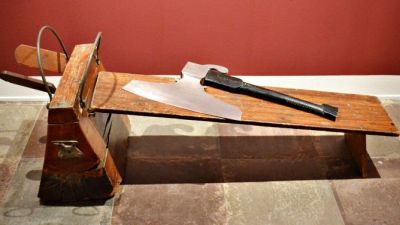 Executioner's
axe and bench.
The very next morning at At 7.15, Jens Nielsen was taken from his cell to the
prison's "Vestre Gård" (western yard). Outside the prison, between 3- and 400
people had gathered, but they were not allowed entry. A few journalists, Horsens'
mayor, the police chief and the priest were present, and 200 prisoners were
ordered to watch the execution from their cell windows. The police chief read
out the death sentence. When Jens didn't want to talk to the priest and didn't
want to say anything, the mayor said "Well then, may God be with you", to
which Jens replied "Thank you Mayor". After this, he went confidently
onto the scaffold. Here he knelt down himself and laid his head on the block.
Right up until the ax fell, he kept his composure. The executioner, the Kingdom
of Denmark's Skarpretter, Theodor Sveistrup raised the axe, and at 7.30 he
separated the head from the body with a single blow. It was somewhat better than
at his previous execution, where Sveistrup had to chop three times. The
journalist Henrik Cavling wrote about the execution: "The sound that was
heard sounded like when you hit a wet sponge against a wall - then you heard a
faint sound of metal. It was the 15 inch long half-round egg that was calmly
pulled through the slit. The head fell into the tin cup and rolled from there
into the gravel." With this, the last execution for crimes committed in
peacetime was over, even though Jens had not actually committed a crime that
could result in the death penalty according to the applicable Penal Code from
1866. After the execution, the body was placed in a coffin with the head between
the legs and taken to the prison mortuary, where it lay until the evening, when
it was taken to the cemetery and buried. Jens Nielsen would have turned 30 later
that month.
Later researchers do not believe that Jens was a psychopath in the clinical
sense, but he harbored a number of borderline traits and he harbored a deep
hatred of society and all authorities, presumably nourished by the way he had
seen his mother behave towards the superintendents of the poorhouses, whom she
often stood up to, and then the treatment he himself received from the same
superintendents. Despite his mother often helping him when he was a boy, he
didn't really care much for her, and apart from his sister, he despised the rest
of his family. His goal in his crimes, in addition to getting the easy life he
thought he deserved, especially the three attempted murders while in prison, was
perhaps, when he couldn't get love, to get attention.